
Fire, Flooding, and Fail-Safe Designs of Marine Lifts
A marine lift has to do much more than move people or equipment between decks. It operates within a vessel that is constantly moving, often with limited space, while potentially being exposed to water, humidity, vibration, power loss and even fire.
For superyachts, offshore vessels, and naval vessels, these factors need to be considered from the earliest stages of design. A marine lift cannot simply be treated as a conventional building lift adapted for use at sea. Its structure, materials, controls, doors, and safety systems all need to work with the vessel around them.
For us, one of the most important considerations is something that can easily be overlooked: the safety of the people who maintain the lift.
Our experience designing and supplying lifts for different areas of the maritime industry demonstrates that marine lift safety is about much more than the person inside the car. It encompasses the engineers working in the lift pit, the vessel’s fire boundaries, the materials used throughout the system, emergency procedures, and the conditions in which the lift will operate. From fire-rated doors and watertight hatches to emergency power, corrosion-resistant materials and physical protection in the lift pit, marine lift safety is built around multiple layers of protection.
Why is Marine Lift Safety Different at Sea?
The fundamental principles of lift safety remain consistent across different applications. What changes is the environment in which the lift has to operate. A vessel is constantly subject to rolling and pitching, creating forces that need to be accounted for during engineering and structural calculations. Space can also be severely restricted, both horizontally and vertically, with conventional lift pits or overhead spaces often impossible to accommodate. There are additional considerations too. A lift may need to pass through fire boundaries or a watertight deck, while some installations can be exposed directly to rain, seawater, and humidity.
These challenges apply across the yachting, offshore, and naval sectors, although their relative importance can differ. Superyacht projects typically place greater emphasis on aesthetics, available space, and noise, while offshore and naval projects tend to prioritise functionality and reliability. Across all three, however, safety remains fundamental.
This is why marine lift safety needs to be considered alongside the wider vessel design rather than after the lift itself has been specified.
Discover our range of custom marine lifts
Fire Protection Starts With The Vessel’s Fire Boundaries
Fire is one of the most serious risks to consider when integrating a lift into a vessel.
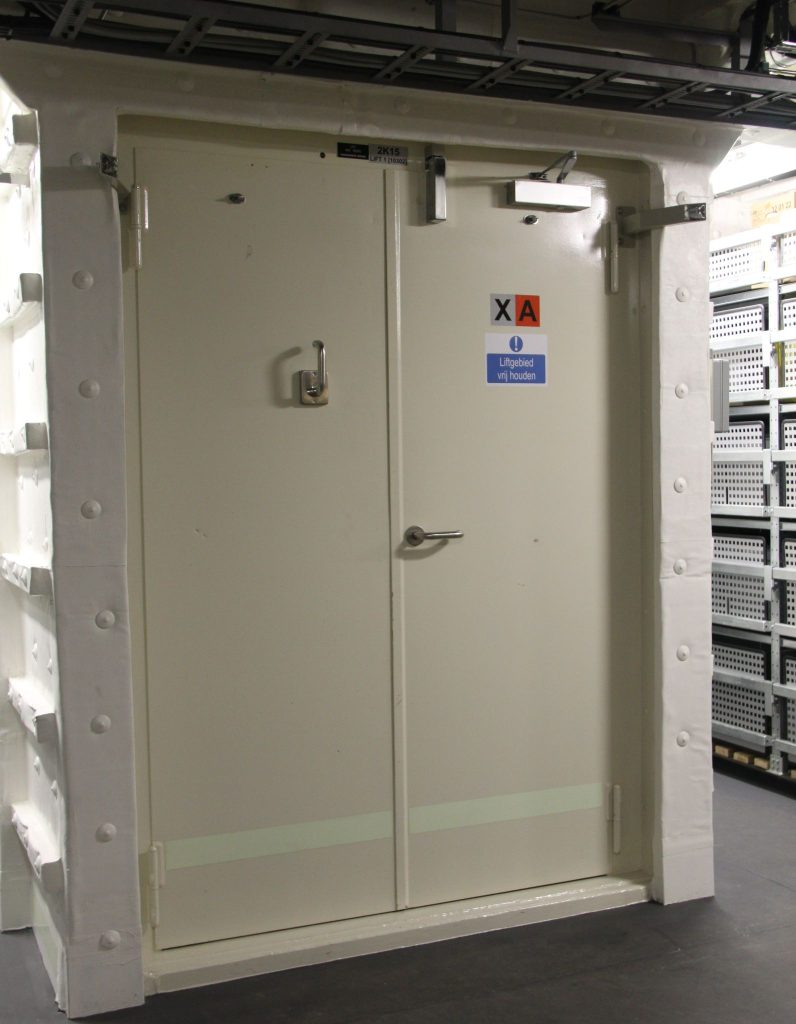
Because a lift can connect multiple decks, its doors and shaft openings need to be considered as part of the vessel’s fire protection strategy. If a fire begins elsewhere on the vessel, the lift must not inadvertently provide an easy route for fire and smoke to spread between decks.
The first step is therefore understanding where the vessel’s fire boundaries are and what protection is required at each lift opening.
Fire-Rated Marine Lift Doors
It is essential to work to each vessel’s requirements and classification. SOLAS, the International Convention for the Safety of Life at Sea, contains specific requirements relating to fire protection, with A-0 and A-60 protection being the classifications related to marine lifts.
Although essential, doors are only one part of the solution.
Materials and Cabling
Fire considerations also influence the materials used within the lift.
We consider non-flammable materials and suitable marine-grade electrical cabling, with the aim of avoiding materials that could create additional hazards or toxic smoke during a fire. Batteries and other potentially hazardous materials also need to be appropriately selected and documented.
For offshore and naval projects in particular, documentation and certification can form a significant part of the approval process. Component certificates, material specifications, and production information may all need to be reviewed before production can begin. The result is a broader approach to marine lift safety, where fire protection is considered across the complete system rather than relying on a single fire-rated component.
How Are Marine Lifts Protected From Water and Corrosion?
Fire is not the only environmental risk. Water and moisture can significantly impact marine lift components, particularly when a lift extends through an exterior deck. The level of exposure depends on the installation. A lift positioned entirely inside a vessel may be relatively protected, whereas one that emerges through a deck can be exposed to rain and seawater.
These different exposure levels can influence material selection and long-term performance.
Corrosion-Resistant Marine Lift Materials
We use materials such as 316 stainless steel for exposed components, helping them withstand moisture and saltwater. Other parts of the lift are protected through suitable marine-grade paint systems, where surface preparation and the quality of the coating are important for preventing corrosion.
The materials and protective coatings used therefore depend on where the lift is installed and how much exposure it will have to the elements. An interior-only lift has different requirements from one that passes through an exterior deck, making the installation environment an important consideration during the design process.
Watertight Hatches
A lift operating through a watertight hatch introduces another important safety consideration.
The lift needs to interact correctly with the hatch, with controls and end-limit switches preventing the lift from travelling through the deck when the hatch is not fully open. This prevents the lift and hatch from entering a potentially dangerous sequence.
Where water can enter the shaft, drainage also needs to be considered. Water will collect in the lift pit, so the vessel may require an appropriate bilge arrangement to remove it.
These requirements demonstrate why the lift manufacturer and shipyard need to work together. The lift cannot be designed independently from the structure and systems surrounding it.
Find out more about HML’s lift services
What Happens to a Marine Lift During a Power Failure?
A loss of power is another scenario that needs to be considered during the design stage.
For passengers, the priority is providing a safe means of exiting the lift if normal power is lost. We can incorporate an uninterruptible power supply (UPS), allowing the lift to perform an emergency sequence and travel to an appropriate deck before opening its doors.
Where required, the lift can also be connected to the vessel’s emergency power system. The controller can be programmed to respond to different emergencies. For example, following a fire alarm, the lift can be configured to travel to a designated deck, stop and open its doors. If that deck is affected by the fire, an alternative destination can be programmed instead. The system can also communicate information back to the bridge, including fault signals and the status of relevant doors or hatches.
These functions form an important part of marine lift safety because they allow the lift to respond automatically to predefined emergency conditions rather than relying entirely on manual intervention.
Limited Space Creates Its Own Safety Challenges
Space is one of the defining challenges of marine lift engineering.
A conventional building can be designed around the requirements of a lift. On a vessel, the lift has to fit within an existing structural arrangement alongside stiffeners, insulation, machinery, and other systems.
The requirements therefore need to be established early.
Before any lift project, we need to know multiple factors, including the number of decks, required speed, lift dimensions, and safe working load. For example, for an offshore or naval lift transporting pallets, the car needs to accommodate the pallet and the required load; whether that load is 1,000kg, 5,000kg, or 10,000kg affects the structural calculations and therefore the space required.
Even apparently straightforward dimensions can change once the surrounding structure is taken into account. Stiffeners and insulation can reduce the usable space within the shaft, creating conflicts between the lift’s requirements and the vessel’s structure.
That is why these discussions need to happen at the beginning of a project. If there is insufficient room, the client may need to alter the available space or reconsider the size of the lift car.
Protecting Engineers in the Lift Pit
The restricted space found on vessels also creates a specific maintenance risk.
One of the biggest safety concerns is the protection of personnel working in the lift pit. Unlike a building, where a lift pit can be constructed to provide a standard amount of working clearance, a vessel may not have enough depth available.
If needed, we incorporate physical safeguards such as an automatically folding safety pole or a removable safety pole to create a protected area for an engineer working in the pit. This is an important aspect of marine lift safety because the people maintaining the equipment need to be considered just as carefully as those using it.
Designing Safety Into The Lift From the Start
Fire, flooding, and power failure may appear to be separate risks, but they all demonstrate the same underlying principle: a marine lift has to be designed around the vessel and the conditions in which it will operate.
Fire-rated doors need to correspond with the vessel’s fire boundaries. Materials need to suit the environment and minimise additional risks in the event of a fire. Watertight hatches need to interact correctly with the lift controls. Emergency power and UPS systems need to support appropriate responses to power loss. Restricted lift pits need physical safeguards for maintenance personnel.
None of these features can be considered effectively in isolation
For us, the process begins with understanding what the client needs the lift to do and what the vessel can accommodate. The number of decks, available space, required load, speed, door arrangements, and surrounding structure all influence the eventual design.
That early collaboration is particularly important because a marine lift is only one part of a much larger vessel project. We work closely with shipyards throughout the design and installation process to ensure that decisions are made at the right stage and that the lift can be installed safely within the vessel’s construction programme.
Ultimately, marine lift safety comes from combining engineering, appropriate materials, tested safety systems, and practical consideration of how the equipment will be used and maintained.
For superyachts, offshore vessels, and naval vessels, that approach helps create marine lift systems that are not only designed to meet the required standards, but are also suited to the real conditions of life and work at sea.